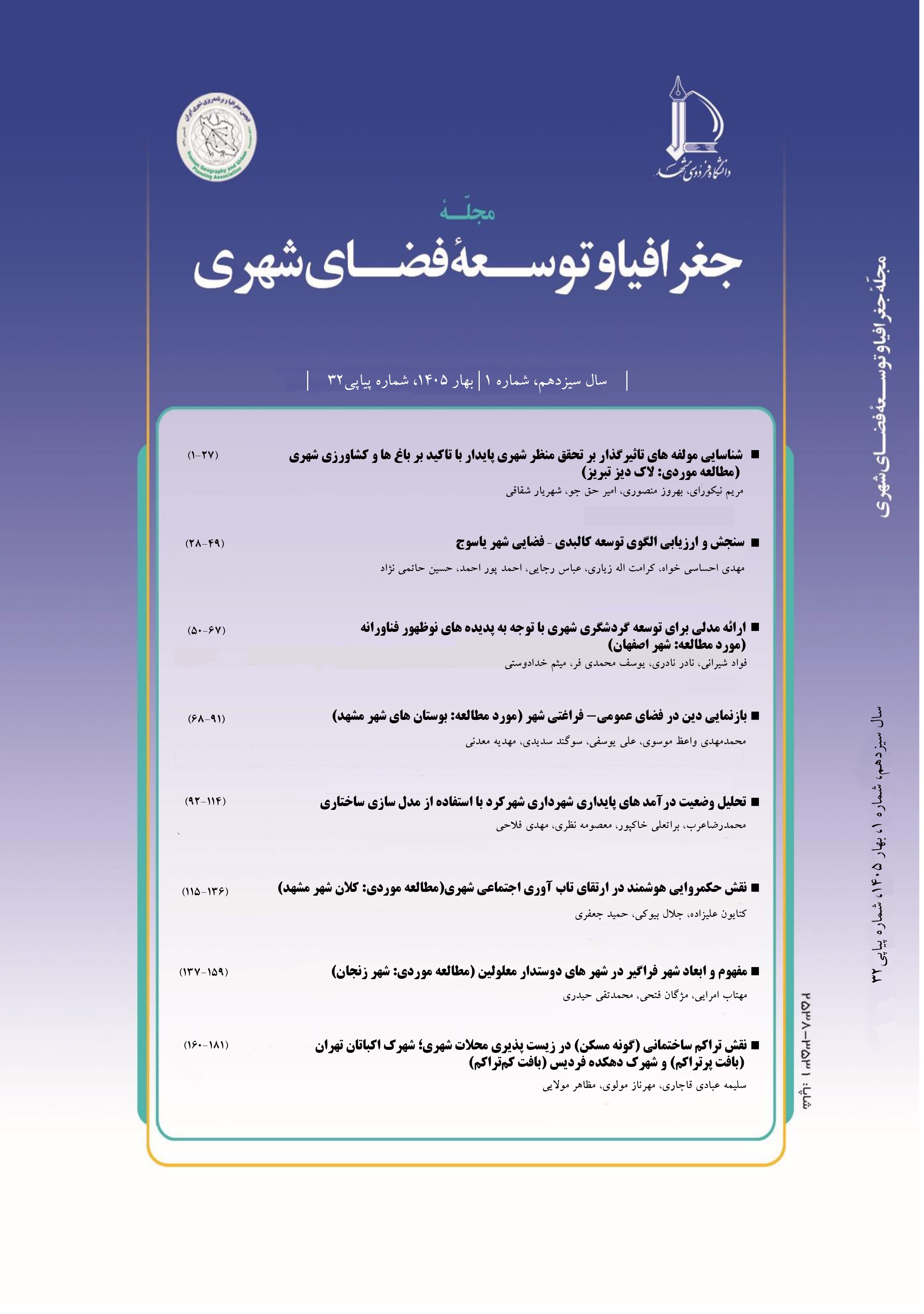
تحلیل وضعیت درآمدهای پایدار شهرداری‌ شهر کرد با استفاده از مدل سازی ساختاری

نوع مقاله : علمی - پژوهشی

نویسندگان

1 دانشجوی دکتری جغرافیا و برنامه ریزی شهری، دانشگاه فردوسی، مشهد، ایران

2 دانشیار گروه جغرافیا و برنامه ریزی شهری، دانشگاه فردوسی، مشهد، ایران

3 رئیس هیات مدیره مهندسین مشاور طرح آوران محیط شرق

4 دانش آموخته دکتری جغرافیا و برنامه ریزی شهری، دانشگاه تبریز، تبریز، ایران

5 دانشجوی کارشناسی ارشد جغرافیا و برنامه ریزی شهری، دانشگاه فردوسی، مشهد، ایران

چکیده
درآمدهای شهرداری‌ها معمولاً از منابعی مانند مالیات‌ها، عوارض و هزینه‌های خدمات شهری، درآمدهای اقتصادی از طریق صنایع و تجارت و اعتبارات و وام‌های مختلف تأمین می‌شوند. شناسایی و طراحی درآمدهای پایدار به‌عنوان پشتوانه‌ای جهت تحقق برنامه‌های توسعه شهری امری ضروری می‌باشد، دسترسی شهرداری‌ها به منابع درآمدی مطلوب و پایدار باعث می‌شود که شهرداری، نقش فعال‌تری در ساختار شهری اجرا کند. پژوهش حاضر از نوع توصیفی - تحلیلی می‌باشد. جامعه آماری این پژوهش کلیه مدیران و مسئولان و کارشناسان شهرداری شهری شهرکرد را تشکیل می‌دهند. در این راستا تعداد 50 پرسش‌نامه با طیف لیکرت بین پاسخگویان توزیع‌ شده است. پایایی ابزار تحقیق با استفاده از آلفای کرونباخ مقدار 840/0 برآورد شد که نشان‌دهنده مطلوبیت پرسش‌نامه است. برای تجزیه‌وتحلیل توصیفی و استنباطی داده‌ها از آزمون آماری T-Test در نرم‌افزار SPSS و جهت تبیین و مدل‌سازی اثرات نیز از مدل‌سازی معادلات ساختاری در نرم‌افزار AMOS استفاده گردید. نتایج حاصل از آزمون T تک نمونه‌ای پژوهش نشان داد وضعیت همه ابعاد درآمدهای شهرداری در محدوده موردمطالعه با میانگین 30/2 در وضعیت قابل‌قبولی قرار ندارند. تحلیل یافته‌های منتج از مدل‌سازی معادلات ساختاری بیانگر این است که مقدار وزن رگرسیونی شاخص RMSEA برابر با (65/0) است که نشان‌دهنده مطلوبیت مدل می‌باشد. همچنین تحلیل کلی مدل نشان داد که متغیر درآمدهای حاصل از عوارض ساختمانی بیشترین بار عاملی را با وزن رگرسیونی (96/0) را دارا می‌باشد و کمترین بار عاملی هم به بعد درآمد حاصل از کمک‌ها و اعانات و هدایای شهرداری با وزن عاملی (35/0) تعلق دارد.

کلیدواژه‌ها

موضوعات

عنوان مقاله English

Analyzing the Status of Sustainable Municipal Revenues in Shahr-e Kord Using Structural Modeling

نویسندگان English

Mohammad Reza arab 1
Baratali Khakpour 2
mahdi fallahi 3
Massoumeh Nazari 4
Sara Alizadeh Moradi 5
1 Ph.D. Candidate in Geography and Urban Planning, Ferdowsi University of Mashhad, Mashhad, Iran, Corresponding Author
2 Associate Professor, Department of Geography and Urban Planning, Ferdowsi University of Mashhad, Mashhad, Iran
3 Chairman of the Board of Directors, Tarh Avaran Mohit-e Shargh Consulting Engineers
4 Ph.D. in Geography and Urban Planning, University of Tabriz, Tabriz, Iran
5 M.A. Student in Geography and Urban Planning, Ferdowsi University of Mashhad, Mashhad, Iran
چکیده English

Abstract
Municipal revenues are typically generated from sources such as taxes, fees and charges for services, economic income from industries and businesses, and various credits and loans. Identifying and designing sustainable revenues as a backing for the realization of urban development plans is essential.
Municipalities' access to desirable and stable revenue sources allows them to play a more active role in the urban structure. The present study is descriptive-analytical in nature. The statistical population of this research consists of all managers, officials, and experts of Shahrkord Municipality. In this context, 50 questionnaires with a Likert scale were distributed among the respondents. The reliability of the research tool was estimated using Cronbach's alpha to be 840/0, indicating the desirability of the questionnaire. For descriptive and inferential data analysis, the T-Test statistical test was used in the SPSS software, and for explaining and modeling the effects, structural equation modeling was used in the AMOS software. The results of the one-sample T-test of the research showed that the status of all dimensions of municipal revenues in the study area with an average of 30/2 are not in an acceptable situation. Analysis of the findings resulting from structural equation modeling indicates that the regression weight value of the RMSEA index is equal to (65/0), which indicates the desirability of the model. Also, the general analysis of the model showed that the variable of revenue from building permits has the highest factor load with a regression weight of (96/0), and the lowest factor load belongs to the dimension of revenue from donations and gifts to the municipality with a factor load of (35/0).

Keywords: sources of income, municipality, sustainable income, modeling, Shahrekord


Extended abstract
1.Introduction
Municipal revenue sources play a crucial role in the quality of services provided to citizens. If municipalities are unable to generate sufficient revenue, they will be unable to establish and maintain essential infrastructure within the city. Currently, the greater reliance of municipalities on unsustainable revenues leads to fundamental problems in all aspects of the city, including its physical form and urban landscape, and consequently, the quality of life of citizens decreases. If municipalities are unable to build infrastructure and provide the necessary services for development, urban development will be disrupted. Achieving sufficient and sustainable urban revenues becomes even more important when experts believe that the urban revenue structure can shape its future development from the standpoint of sustainability. Therefore, identifying the revenue structure in terms of sustainability or unsustainability plays a pivotal role in formulating urban development plans and policymaking.

2. Method
The prevailing approach in this research is developmental-applied, and its research method is descriptive-analytical and survey. The theoretical framework of the research was conducted using the library method and reviewing the relevant literature. The research statistical population is the entire staff of Shahr-e Kord Municipality, which includes members of the City Council, members of the Municipality, senior financial managers and deputies, consultants and experts, and supervisory and consulting engineers of Shahr-e Kord Municipality. The classification and valuation of indicators were carried out using a five-point Likert scale. The statistical population in this study was selected as a total sample of 50 people as the research statistical population, and on this basis, 50 questionnaires were prepared and distributed and were collected after completion. The collected data from the questionnaire were analyzed and examined using the AMOS software and statistical analysis methods such as the one-sample T test in the SPSS software environment.

3. Results

The status of Shahr-e Kord Municipality's revenue regarding the significance level (000/0) and its comparison with the allowable error of 5% and the confidence level of 95% is in an unfavorable situation and is considered unsustainable in terms of all revenue indicators (public and private revenue). Among the five dimensions of municipal revenues, the factor of revenues from building permits has the highest factor load with a weight of 96/0. After that, revenues from transportation and communications with a factor load of 95/0 are in second place, the third rank of sustainable revenues of Shahr-e Kord Municipality is allocated to revenues from licenses for business and sale with a regression weight of 76/0, and finally the fourth and fifth ranks belong to the two dimensions of revenues from municipal properties and revenues from donations and gifts to the municipality with factor loads of 42/0 and 35/0, respectively.

4. Discussion and Conclusion

Municipal revenue sources should be such that they provide the process of the city’s move towards sustainable urban development and follow the characteristics of sustainability. Therefore, the present study examines the status of the revenue indicators of Shahr-e Kord Municipality and studies its desirability. The results show that the revenue status of Shahr-e Kord Municipality is in an unfavorable situation and is considered unsustainable. In explaining and justifying these results, it can be stated; The decrease in revenue from building permits can be due to various reasons such as a decrease in construction, tax evasion, and low tax rates. It also seems that the decrease in revenue from transportation and communications can also be due to the lack of development of public transportation infrastructure, the use of personal vehicles, and the non-payment of transportation taxes. In the meantime, it may be that the decrease in revenues from funds and donations and gifts to the municipality is due to a decrease in the private sector's desire to invest in the city and the lack of government support for Shahr-e Kord Municipality. In relation to the instability of the revenues from the sale of licenses for municipal properties, it can be stated; In an economic recession, the tendency to invest in real estate decreases. This leads to a decrease in demand for the purchase of real estate, including municipal-owned properties, and in relation to the decrease in revenues from municipal funds and properties, it can be pointed to the inefficient management of resources in Shahr-e Kord Municipality. Therefore, given the revenue instability of Shahr-e Kord Municipality, this organization needs to adopt appropriate strategies in the field of diversifying and increasing sustainable revenue sources to achieve financial sustainability and provide quality urban services to citizens.

کلیدواژه‌ها English

Revenue Sources
Municipality
Sustainable Revenues
Modeling
Shahr-e Kord
  1. اسدپور، ا. (1395). واکاوی درآمد پایدار شهرداری ها با رویکرد توسعه پایدار شهری؛ مطالعه موردی در شهر بندرعباس. فصلنامه مدیریت شهری، 16(46)، 112-97.
  2. برسم، ل.، مغانی، ب.، و خبازی، م. (1395). ارزیابی منابع مالی شهر داری ها و امکان سنجی تأمین درآمد های پایدار شهری (مطالعه موردی: شهر جیرفت). فصلنامه جغرافیا و روابط انسانی، 2(3)، 203-182.
  3. خان محمدی، م.، خوشکار، ف.، و سعادت آگاه، ف. (1398). بررسی رابطه بین منابع درآمدی و وظایف شهرداری (مطالعه موردی: شهرداری تهران). فصلنامه چشم انداز حسابداری و مدیریت، 2(13)، 8-72.
  4. دانش جعفری، د.، بابا جانی، ج.، و کریمی اسبویی، س. (1393)، ارزیابی پایداری منابع مالی و درآمدی شهرداری تهران. فصلنامه اقتصاد و مدیریت شهری، 2(7)، 34-15.
  5. رستمی، و. (1395). شهرداری در نظام حقوقی ایران و فرانسه. نشریه علمی پژوهشی مطالعات حقوق تطبیقی، 7(1)، 161-141.
  6. زیاری، ک.، مهدی، ع.، و مهدیان بهمنیری، م. (1391). مطالعه و شناخت منابع مالی و ارائه راهکارهایی برای بهبود پایداری درآمد شهرداری ها؛ مورد پژوهش؛ شهرداری شهر مهاباد. فصلنامه مدیریت شهری، 11(31)، 124-107.
  7. سبحانیان، م.، آقاجانی معمار، ا.، و توتونچی ملکی، سعید. (1395). مالیات بر عایدی سرمایه املاک و مسکن؛ منبع درآمدی پایدار برای شهرداری‌ها و ابزاری به‌منظور کنترل سوداگری در بازار مسکن. فصلنامه علمی- پژوهشی اقتصاد و مدیریت شهری، 6(21)، 96-83.
  8. شریف نژاد، ن.، صابری، ح.، خادم الحسینی، ا.، زیاری، ک.، و اذانی، م (1399). ارزیابی مؤلفه های تاثیر گذار بر پایداری ساختار درآمدی شهر داری ها (مطالعه موردی: کلان شهر اصفهان). فصلنامه علمی پژوهشی نگرش های نو در جغرافیای انسانی، 12 (2)، 266-252.
  9. فشارکی غلامی، م. (1396). مدل معادلات ساختاری و کاربرد آن در مطالعات روانشناسی: یک مطالعه مروری. دو فصلنامه علمی پژوهشی روانشناسی بالینی و شخصیت، 16(1)، 265-253.
  10. قربانی، ر.، و عظیمی، م.، (1394). بررسی تاثیرساختار درآمدی شهرداری بر روند توسعه شهری با استفاده از تکنیک ضریب همبستگی و تحلیل عاملی، مطالعه موری مشهد. فصلنامه پژوهش و برنامه‌ریزی شهری، 3(5)، 132-115.
  11. قلی پور، ر.، درویش زاده، م. م.، و پیران نژاد، علی. (1398). بررسی روش ها، منبع ها و مانع های دستیابی به درآمد پایدار شهری (مطالعه موردی: شهرداری ارومیه). فصلنامه مدیریت دولتی، 11(1)، 178-151.
  12. قنبری، ا.، موسوی، م.، سعید آبادی، ر.، باقری کشکولی، ع.، و حسینی امینی، ح، (1390). راهکارهای توانمندسازی افزایش درآمد شهرداری ها در شهرهای کوچک (مطالعه موردی: شهر زارچ). مجله جغرافیا و برنامه ریزی محیطی، 25(42)، 58-41.
  13. کامیار، غ. ر. (1385). حقوق شهری و شهر سازی. تهران: انتشارات مجد.
  14. مسگری، س.، نعیمی، ص.، و عبدالشاه، م. (1397). بررسی عوامل موثر بر درآمد شهرداری ها و ارائه راهبرد های مناسب به منظور ایجاد درآمد پایدار. فصلنامه تحقیقات جغرافیایی، 33(2)، 88-75.
  15. معروفی، ف.، و امامی، ع. (1396). ارائه مدل برنامه ریزی استراتژیک شهرداریها، مورد مطالعه شهر داری ملایر سال 1400-1396. فصل نامه آمایش محیط، 10(38)، 144-121.
  16. نثاری، ر.، منتظری، ر.، و حسین زاده، ن. (1394). راهبردهای تأمین مالی پایدار شهر داری تهران در برنامه پنج ساله، با تاکید بر سیاست های ابلاغی اقتصاد مقاومتی. فصلنامه علمی- پژوهشی اقتصاد و مدیریت شهری، 3(11)، 116-99.
  17. Rodríguez-Pose, A., & Palavicini-Corona, E. I. (2013). Does local economic development really work? Assessing LED across Mexican municipalities. Geoforum44, 303-315.
  18. Chetan, V., & Hitesh, V. (2011). Creative Financing of Urban Infrastructure In India Through Market–based Financing and Public Private Partnership Options. University of Toronto, new Delhi National Institute of Public Finance and Policy new Delhi, (3-7).
  19. Dirie, I. (2005). Municipal finance: Innovative resourcing for municipal infrastructure and service provision. In A report prepared for the Commonwealth Local Government Forum in cooperation with ComHabitat.
  20. Janoušková, J., & Sobotovičová, Š. (2019). Fiscal autonomy of municipalities in the context of land taxation in the Czech Republic. Land Use Policy82, 30-36.
  21. Haraldsson, M. (2017). When revenues are not revenues: the influence of municipal governance on revenue recognition within Swedish municipal waste management. Local Government Studies43(4), 668-689.
  22. Park, S. (2017). Local revenue structure under economic hardship: reliance on alternative revenue sources in California counties. Local Government Studies43(4), 645-667.
  23. Ojo, S. S., Tpl, D. B., & Pojwan, M. A. (2017). Urbanization and urban growth: Challenges and prospects for national development. Journal of Humanities and Social Policy3(1), 65-71.
  24. Ji, X., Wang, K., Xu, H., & Li, M. (2021). Has digital financial inclusion narrowed the urban-rural income gap: The role of entrepreneurship in China. Sustainability13(15), 8292.
  25. Frare, M. B., Clauberg, A. P., Sehnem, S., Campos, L. M., & Spuldaro, J. (2020). Toward a sustainable development indicators system for small municipalities. Sustainable Development28(5), 1148-1167.
  26. Liu, A. Y., Oi, J. C., & Zhang, Y. (2022). China’s local government debt: the grand bargain. The China Journal87(1), 40-71.
  27.  Engin, Z., van Dijk, J., Lan, T., Longley, P. A., Treleaven, P., Batty, M., & Penn, A. (2020). Data-driven urban management: Mapping the landscape. Journal of Urban Management, 9(2), 140-150.
  28. Satterthwaite, D. (2021). Sustainable cities or cities that contribute to sustainable development?. In The Earthscan reader in sustainable cities (pp. 80-106). Routledge.
  29. Tejedo-Romero, F., Araujo, J. F. F. E., Tejada, Á., & Ramírez, Y. (2022). E-government mechanisms to enhance the participation of citizens and society: Exploratory analysis through the dimension of municipalities. Technology in Society70, 101978.
  30. Allen, B., Tamindael, L. E., Bickerton, S. H., & Cho, W. (2020). Does citizen coproduction lead to better urban services in smart cities projects? An empirical study on e-participation in a mobile big data platform. Government Information Quarterly37(1), 101412.
ارسال نظر در مورد این مقاله
نام را وارد کنید.
نشانی پست الکترونیکی را به درستی وارد کنید.
وابستگی سازمانی را به درستی وارد کنید.
توضیحات را وارد کنید (حداقل 50 حرف)
CAPTCHA Image
شناسه امنیتی را به درستی وارد کنید.

  • تاریخ دریافت 10 خرداد 1403
  • تاریخ بازنگری 16 مهر 1403
  • تاریخ پذیرش 14 آبان 1403