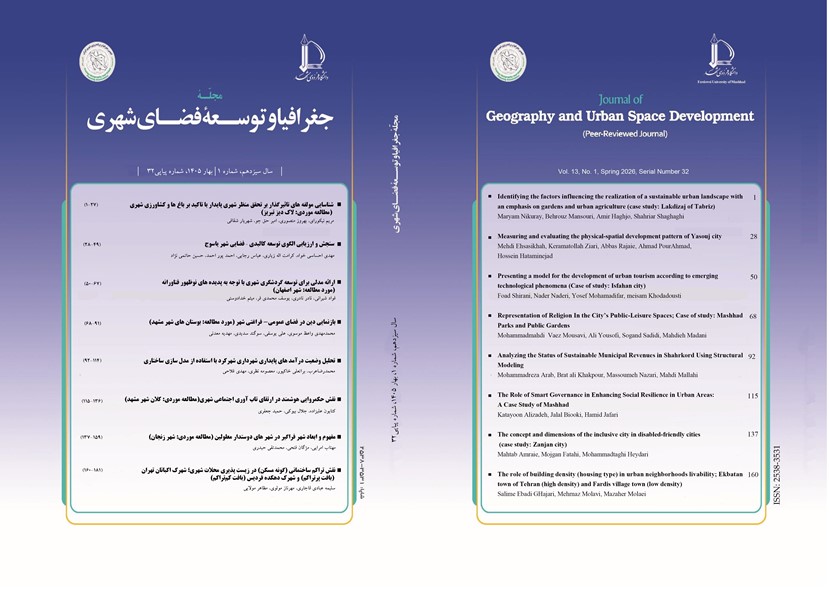
The Concept and Dimensions of the Inclusive City in Disability-Friendly Cities (Case Study: Zanjan City)

Document Type : Scientific-Research

Authors

1 Ph.D. Candidate in Geography and Urban Planning, Faculty of Social Sciences and Geography, University of Zanjan, Zanjan, Iran.

2 Associate Professor of Geography and Urban Planning, Faculty of Social Sciences and Geography, University of Zanjan, Zanjan, Iran.

Abstract
Abstract
The city of Zanjan has more than 22 thousand disabled people, and this number includes 1.7% of the population of Zanjan, which is a high number for the growing city of Zanjan. Therefore, in the current research, the main hypothesis of the research, i.e. the concept and dimensions of the inclusive city in disabled-friendly cities (case study: Zanjan city) was investigated. In terms of its purpose, this research is a part of applied research and of the type of qualitative studies, interpretive phenomenological research method. The participants in this research were 17 urban planning experts, and the snowball sampling method was used. Data collection was done through the survey method of structured interview through the type of open questions. In this research, thematic analysis method was used to analyze qualitative findings using MAXQDA software. In the present research, in order to design the concept of a disabled-friendly city, it was carried out through the alignment process in different stages. Experts' opinions were used to measure the validity of the research in the qualitative part. Clavizi method was used to analyze the findings, and at the end, the obtained themes were placed in five general and central indicators. The theoretical and qualitative findings of the research show that the right to the city of Lefort is the best justification to support the current research. The findings from the interviews with experts show that the criteria of the disabled-friendly city in Zanjan in order to achieve the rights of the disabled in five indicators; Social dimension, economic dimension, space allocation right dimension, urban participation right dimension and spatial dimension were categorized.

Keywords: Inclusive City, Disabled, Disabled Friendly City, Lufer, Zanjan


Extended abstract
1. Introduction
The rapid growth of urbanization in the twentieth century has been accompanied by increasing pollution, environmental degradation, and managerial incoherence, highlighting the need to reconsider urban management systems. In Iran, the structure of urban management also faces challenges that reduce the effectiveness of policies. In this context, the inclusive city approach—benefiting from new technologies and framed within sustainable development—seeks to improve quality of life, promote spatial justice, and reduce inequalities. This approach emphasizes support for vulnerable groups, particularly persons with disabilities, who constitute about 15% of the world’s population and nearly 4% of Iran’s population, a significant portion of whom require adequate access to urban services.
Inadequate urban spaces limit the social participation of people with disabilities and lead to their isolation and deprivation. Standards of disability-friendly cities go beyond the removal of physical barriers and emphasize the realization of citizenship rights, health, and the presence of people with disabilities in urban spaces. The city of Zanjan, with more than 22,000 persons with disabilities and a rapidly expanding urban development process, requires planning based on the principles of an inclusive city. The present study, drawing on Lefebvre’s theory, examines the factors affecting the realization of the rights of persons with disabilities in Zanjan and explains the dimensions of a disability-friendly city.

2. Method
In terms of purpose, this study is applied research, and in terms of approach it is qualitative, using an interpretive phenomenological method. The participants included urban planning specialists (professors and students) from the city and universities of Zanjan. Due to the undefined statistical population, participants were selected through snowball sampling. In total, 17 individuals participated in structured interviews with open-ended questions. Theoretical saturation was achieved in the fourteenth interview, but interviews continued until the seventeenth participant to increase the credibility of the findings. Data were analyzed using thematic analysis with the MAXQDA software based on the Attride‑Stirling thematic network framework. To enhance validity, data triangulation and participant feedback were also applied.
Data analysis followed the Colaizzi method. First, the interviews were reviewed several times and key statements were extracted and coded. Then the concepts were organized into thematic clusters and the main themes were identified. Finally, the conceptual framework of a disability-friendly city was developed, and the themes were categorized into five key indicators based on Lefebvre’s theory of the Right to the City: spatial, economic, and social dimensions; the right to spatial allocation (including quality, safety, accessibility, transportation, and urban form); and the right to urban participation, including inclusiveness, empowerment, justice, urban governance, and support for vulnerable groups.


3. Results
In this section, the theoretical findings of the study are explained with emphasis on the connection between Lefebvre’s Right to the City, social justice, and the concept of a disability-friendly city in Zanjan. Considering the rapid growth of Zanjan and the fact that persons with disabilities constitute about 7.1% of the city’s population, attention to their rights in all urban development programs is essential. The Right to the City theory provides a framework for ensuring dignity, equality, fair distribution of resources (including employment, education, health, housing, and information), and public participation, thereby linking the concept of the inclusive city to the disability-friendly city.
The findings are categorized into several main dimensions. In the right to urban participation, strengthening non-governmental organizations, expanding participation, realizing the right to health, and observing the provisions of the Convention on the Rights of Persons with Disabilities are essential. In the spatial dimension, the adaptation of streets, transportation systems, buildings, and access to urban services is crucial to prevent isolation and physical risks. In the field of land and housing, providing suitable housing and achieving integrated urban management are considered fundamental to the social welfare of persons with disabilities. The right to spatial allocation emphasizes inclusive design, safety, livability, accessibility, and transportation. In the social dimension, improving public awareness, institutional support, and local participation are significant, while in the economic dimension, legal support, social security, and economic empowerment are necessary prerequisites for achieving a disability-friendly city in Zanjan.

4. Discussion and Conclusion
Considering the presence of more than 22,000 persons with disabilities in Zanjan (approximately 7.1% of the population), paying attention to the needs and rights of this group in urban planning is of great importance. This study aimed to examine the concept of the inclusive city and the dimensions of a disability-friendly city in Zanjan, and to demonstrate how this approach can be applied in urban development. In terms of purpose, the research is applied, and in terms of methodology it is qualitative with an interpretive phenomenological approach. The participants included 17 urban planning specialists from universities and institutions in Zanjan who were selected through snowball sampling. Data were collected through structured interviews with open-ended questions and analyzed using thematic analysis in the MAXQDA software. Data triangulation and the Colaizzi method were used to validate the findings. The results revealed that achieving a disability-friendly city in Zanjan requires attention to five main dimensions: the social dimension (local participation, laws, safety, and governmental support), the economic dimension (economic readiness, financial support, and economic dynamism), the spatial dimension (access to urban services, housing, transportation, and environmental quality), the right to spatial allocation (spatial quality, safety, accessibility, and livability), and the right to urban participation (justice, non-discrimination, democracy, and empowerment). Overall, the realization of rights such as adequate housing, employment, education, and access to services and urban spaces can prevent the social isolation of persons with disabilities and improve their physical and mental health. Urban management must also rely on legal frameworks and rights-based documents to provide the conditions necessary for the realization of these rights.

Keywords

Subjects

1. ازندریانی، ع. ا.، و شیرزاد نظرلو، ز. (1397). جایگاه حقوق معلولین در حوزه حقوق شهری. فصلنامه مطالعات راهبردی سیاست‌گذاری عمومی، 8(26).
2. باصولی، م. (1399). منظر شهری دوستدار معلول: رویکرد منظرین در محیط مقصد گردشگری. مجله منظر، 12(52)، 278.
3. بزی، خ. ر.، کیانی، ا.، و افراسیابی‌راد، م. ص. (1389). ارزیابی ترافیک شهری و نیازهای معلولان و جانبازان با استفاده از مدل تصمیم‌گیری (TOPSIS) مطالعه موردی: شهر شیراز. پژوهش و برنامه‌ریزی شهری، 1(3)، 10313.
4. تقوایی، م.، و پیرالو، ح. (1402). تحلیل شاخص‌های مدیریتی مؤثر بر توسعه محلات شهری (مطالعه موردی: شهر کنگان). مجله جغرافیا و توسعه فضایی. 1(12)، 182-159.
5. جلیلی صدرآباد، س.، شیعه، ا.، نوروزی پورفیروز، م.، مینوسپهر، م.، و بیات، ر. (1400). بررسی میزان مناسب بودن فضای شهری برای حضور افراد کم‌توان و ناتوان (نمونه مطالعاتی: خیابان انقلاب اسلامی تهران). فصلنامه اقتصاد و برنامه‌ریزی شهری، 2(3)، 186169.
6. دستیار، و.، و محمدی، ا. (1397). سنجش توانمندسازی معلولین جسمی (معلولین جسمی-حرکتی، احشایی و حسی) و عوامل مرتبط با آن. توانبخشی، 19(4)، 368354.
7. رضایی، م. ر.، و حج‌فروش، ش. (1399). ارزیابی مطلوبیت طراحی فضاهای مسکونی برای معلولان جسمی-حرکتی با رویکرد شهر دوستدار معلولان (مطالعه موردی: شهر یزد). پژوهش‌های جغرافیای انسانی، 52(4)، 14521433.
8. سجادیان، م.، فیروزی، م. ع.، و احمدپور، ا. (1401). واکاوی شهر هوشمند آینده اهواز از منظر کلان‌مؤلفه‌های شکل‌گیری. فصلنامه آینده‌پژوهی شهری، 2(2)، 3518.
9. سلامی، ش.، و مظهری، م. (1401). حق بر سلامت معلولان در حوزه حقوق شهری. دانشنامه‌های حقوقی، 5(15)، 131111.
10. صادقی فسایی، س.، و فاطمی‌نیا، م. ع. (1393). معلولیت؛ نیمه پنهان جامعه. رفاه اجتماعی، 15(58)، 192157.
11. عنابستانی، ز.، سرور، ر.، و مهدوی حاجیلویی، م. (1395). بررسی عوامل مؤثر بر تحولات بازار زمین و مسکن شهری. اقتصاد و مدیریت شهری، 4(14)، 3819.
12. غلامی، ن.، امیر فخریان، م.، و اسدی، ر. (1400). تحلیل رویکردهای حاکم بر مدیریت شهری مشهد درباره توان‌یابان و معلولان شهری. پژوهش‌های جغرافیای برنامه‌ریزی شهری، 9(4)، 11971175.
13. لطیفیان، م.، بنی‌اسد، ا.، و کمالی، م. (1399). بررسی ابعاد اجتماعی معلولیت: یک مرور نظام‌مند. پژوهش‌های مددکاری اجتماعی، 7(26)، 10153.
14. مقامی، ا.، و امیرشاکرمی، م. س. (1397). حق تفریح و فراغت معلولین در پرتو اسناد بین‌المللی. مطالعات حقوقی دانشگاه شیراز، 10(1)، 344305.
15. محمدی، ج.، محمدی، ع. ر.، غفاری گیلانده، ع.، و یزدانی، م. ح. (1400). سنجش تأثیرپذیری شهر از نماگرهای شهر هوشمند (مطالعه موردی: شهر زنجان). پژوهش‌های جغرافیای انسانی، 53(2)، 543521.
16. سازمان بهزیستی کشور. (1403). بازیابی از:https://www.behzisti.ir/
17. مرکز آمار ایران. (1403). بازیابی از:https://amar.org.ir/
 
18. de Oliveira Neto, J. S. (2018). Inclusive Smart Cities: theory and tools to improve the experience of people with disabilities in urban spaces (Doctoral dissertation, Université Paris Saclay (COmUE); Universidade de São Paulo (Brésil)).
19. Gong, W., & Lyu, H. (2017). Sustainable city indexing: Towards the creation of an assessment framework for inclusive and sustainable urban-industrial development. UNIDO.
20. Harrison, J. (2012). Life after regions? The evolution of city-regionalism in England. Regional Studies, 46, 1243–1259.
21. Lindfield, M., & Steinberg, F. (2011). Inclusive cities. Asian Development Bank.
22. Lupton, R., Rafferty, A., & Hughes, C. (2016). Inclusive growth: Opportunities and challenges for Greater Manchester.Manchester: Research Explorer the University of Manchester.
23. McGranahan, G., Schensul, D., & Singh, G. (2016). Inclusive urbanization. Environment and Urbanization, 28(1), 13–34.
24. Ranieri, R., & Ramos, R. A. (2013). After all, what is inclusive growth?. https://ideas.repec.org/p/ipc/oparab/188.html.
25. Rattray, N. A. (2013). Contesting urban space and disability in Highland Ecuador. City & Society, 25(1), 25–46.
26. Salha, R. A., Jawabrah, M. Q., Badawy, U. I., Jarada, A., & Alastal, A. I. (2020). Towards a smart, sustainable, accessible and inclusive city for persons with disability. Journal of Geographic Information Systems, 12, 348–371.
27. Serageldin, M. (2019). Preserving the historic urban fabric in a context of fast-paced change. Historic Cities: Issues in Urban Conservation, 8, 175–184.
28. Shah, P., Hamilton, E., Armendaris, F., & Lee, H. (2015). World-inclusive cities approach paper. World Bank.
29. Syed, Z. S. (2009). Inclusive planning for social integration. https://www.academia.edu/36237776/Inclusive_Planning_as_a_Tool_For_Social_Integration.
30. Taylor, J. L., et al. (2020). Pain in low-income older women with disabilities. Journal of Women & Aging, 32(4), 402–423.
31. UN‑Habitat. (2016). World cities report 2016: Urbanization and development – emerging futures. https://www.academia.edu/43040549/_UN_HABITAT_2016_Urbanization_and_development_Emerging_futures_Nairobi_Autor_159_174_pp.
32. Wang, Y. X., et al. (2019). The mediating role of inclusive leadership. Journal of Nursing Management, 27(4), 688–696.
33. World Tourism Organization. (2016). Tourism for all: Promoting universal accessibility. Madrid.
34. Yigitcanlar, T., & Lee, S. H. (2014). Korean ubiquitous‑eco‑city. Technological Forecasting and Social Change, 89, 100–114.
35. Yigitcanlar, T., Dur, F., & Dizdaroglu, D. (2015). Towards prosperous sustainable cities. Habitat International, 45, 36–46.
36. Yoo, S. J., Min, K. J., Jeong, S. H., & Shin, D. B. (2016). Inter‑ministerial collaboration to utilize CCTV video service operated by the U-City Center of South Korea. Spatial Information Research, 24(4), 389–400.
 
 
Send comment about this article
Enter Name.
Enter a valid email address.
Enter a vaid affiliation.
Enter comments (At leaset 10 words)
CAPTCHA Image
Enter Security Code Correctly.

  • Receive Date 22 August 2024
  • Revise Date 24 November 2024
  • Accept Date 08 February 2025