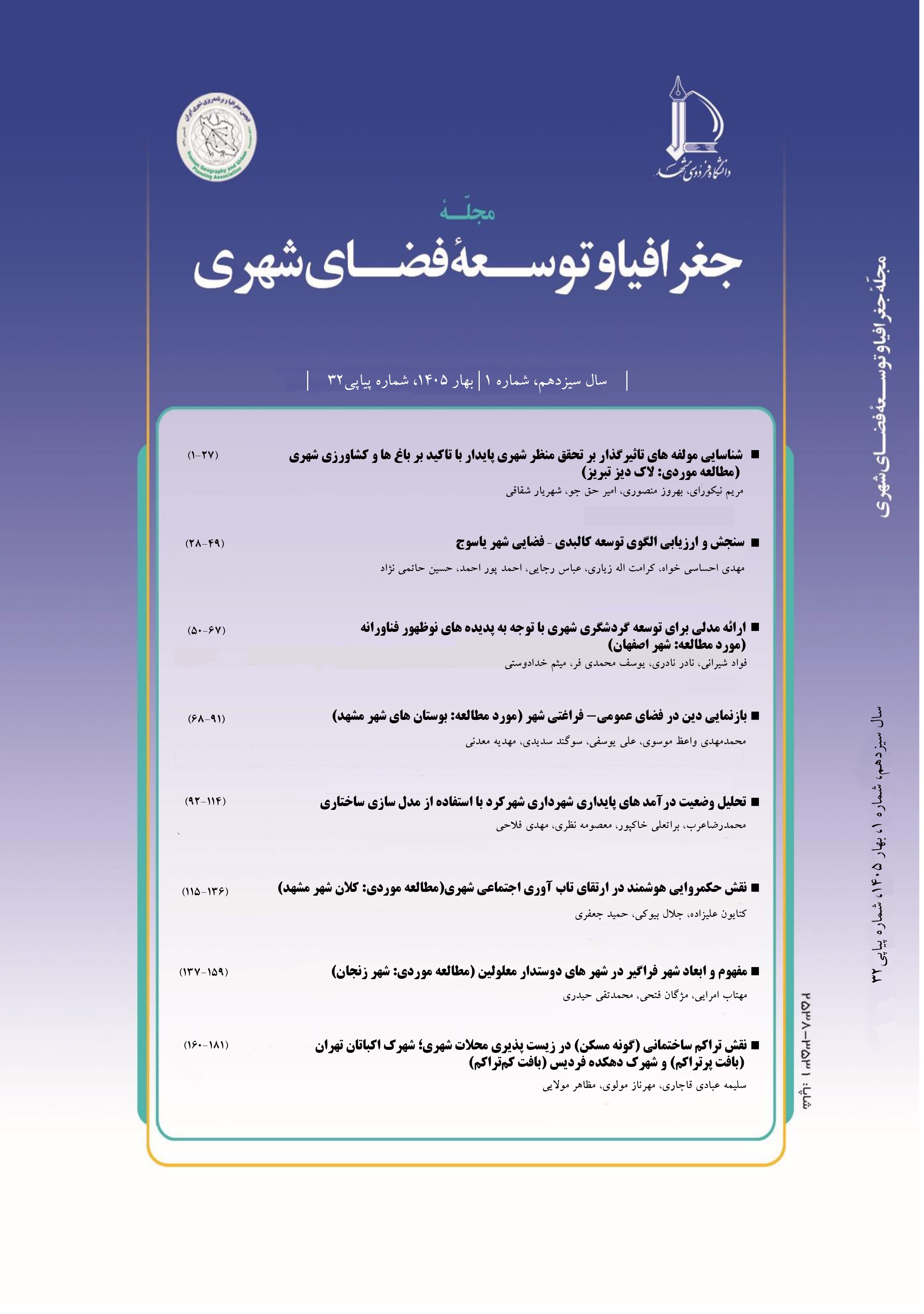
ارائه مدلی برای توسعه گردشگری شهری با توجه به پدیده های نوظهور فناورانه (مورد مطالعه: شهر اصفهان)

نوع مقاله : پژوهشی-مطالعه موردی

نویسندگان

1 دانشجوی دکتری مدیریت کارآفرینی، دانشکده علوم اجتماعی، دانشگاه رازی، کرمانشاه، ایران

2 دانشیار گروه کارآفرینی، دانشکده علوم اجتماعی، دانشگاه رازی، کرمانشاه، ایران

چکیده
علی رغم حجم و سرعت بالای پدیده‌های نوظهور فناورانه و همچنین اهمیت و تأثیر آن‌ها، پژوهش‌های محدودی به بررسی تأثیر این پدیده‌ها بر توسعه گردشگری در شهر اصفهان پرداخته‌اند. بنابراین، این مقاله به ارائه یک مدل محلی برای توسعه گردشگری شهری در اصفهان با توجه به پدیده‌های نوظهور فناورانه می‌پردازد. این تحقیق از نظر هدف کاربردی و از نظر روش جمع‌آوری داده‌ها در دسته تحقیقات توصیفی-پیمایشی قرار دارد و هر دو استراتژی استقرایی و مقایسه‌ای در بخش‌های کیفی و کمی به کار گرفته شده است. بنابراین، در بخش کیفی، با استفاده از نمونه‌گیری نظری و روش گلوله برفی، مصاحبه‌های نیمه ساختارمند با ۱۰ کارشناس مرتبط با موضوع صورت گرفت تا به دست‌آوردن اشباع نظری انجام شود. جامعه‌ی آماری بخش کمی نیز شامل حدود ۱۰۰ مدیر و کارشناس مرتبط با این حوزه تخمین زده شد. با استفاده از جدول مورگان، ۸۰ نفر از مدیران و کارشناسان گردشگری در اصفهان برای تکمیل پرسشنامه انتخاب شدند. برای جمع‌آوری و تجزیه و تحلیل داده‌ها، از ابزارهای مصاحبه و پرسشنامه استفاده شد و نرم‌افزارهای SPSS23 و AMOS برای بررسی هدف پژوهش به کار رفتند. به طور خلاصه، نتایج تجزیه و تحلیل داده‌ها نشان می‌دهند که در زمینه پدیده‌های نوظهور فناورانه، عوامل مختلفی مانند عوامل مدیریتی، ساختاری و مالی به طور مستقل یا ترکیبی و در هم تنیده بر توسعه گردشگری شهری در اصفهان اثر می‌گذارند. در پایان، توصیه‌هایی ارائه شده است که شامل ضرورت تسریع در سیاست‌گذاری مناسب توسط دولت برای ارکان اصلی زیرساخت زیست‌بوم گردشگری با توجه به اثرات ژرف فعالیت‌های نوآورانه فناورانه می‌شود.

کلیدواژه‌ها

موضوعات

عنوان مقاله English

Presenting a Model for the Development of Urban Tourism according to Emerging Technological Phenomena (Case of Study: Isfahan city)

نویسندگان English

Foad Shirani 1
Nader Naderi 2
Yosef Mohamadifar 2
Meysam Khodadousti 1
1 PhD Candidate in Entrepreneurship Management, Razi University, Kermanshah, Iran
2 Assistant Professor in Entrepreneurship and Management, Razi University, Kermanshah, Iran
چکیده English

Abstract
Despite the high volume and speed of emerging technological phenomena as well as their importance and impact, limited researches have investigated the impact of these phenomena on the development of tourism in Isfahan city. Therefore, this article presents a local model for the development of urban tourism in Isfahan with regard to emerging technological phenomena. This research is in the category of descriptive-survey research in terms of practical purpose and in terms of data collection method, and both inductive and comparative strategies have been used in qualitative and quantitative sections. Therefore, in the qualitative part, using theoretical sampling and the snowball method, semi-structured interviews were conducted with 10 experts related to the subject in order to obtain theoretical saturation. The statistical population of the quantitative section was estimated to include about 100 managers and experts related to this field. Using Morgan's table, 80 tourism managers and experts in Isfahan were selected to complete the questionnaire. To collect and analyze data, interview tools and questionnaires were used, and SPSS23 and AMOS software were used to investigate the purpose of the research. In short, the results of data analysis show that in the context of emerging technological phenomena, various factors such as managerial, structural and financial factors independently or combined and intertwined affect the development of urban tourism in Isfahan. In the end, recommendations are presented that include the need to accelerate appropriate policymaking by the government for the main elements of tourism ecosystem infrastructure, considering the profound effects of innovative technological activities.
Keywords: Development, tourism, emerging Isfahan, technological, urban tourism


Extended abstract
1.Introduction
With its rich historical, cultural, and architectural heritage, Isfahan stands as one of the most prominent tourism destinations in Iran and across Asia, playing a vital role in employment, revenue generation, and socio-economic development. As emerging technologies and artificial intelligence increasingly reshape the tourism industry, this study focuses on Isfahan to propose a model for urban tourism development driven by these technological advancements. Unlike previous generalized studies, this research is grounded in empirical data and the specific context of Isfahan.
2. Method
This research employs a mixed-methods approach (qualitative-quantitative). In the qualitative phase, a primary tourism development model was extracted through thematic analysis and semi-structured interviews with 10 experts (selected via purposive sampling). In the quantitative phase, this model was validated through a survey of 80 experts (randomly selected based on the Morgan table) using a structured questionnaire. Data collection involved documentary studies, interviews, and questionnaires. The final data analysis was conducted using descriptive and inferential statistics, specifically Structural Equation Modeling (SEM) via SPSS and AMOS software.
3.Results
Utilizing a qualitative approach (expert interviews) and statistical analysis, this study formulated an urban tourism development model for Isfahan, with an emphasis on emerging technologies. Content analysis identified 26 key factors, which were subsequently categorized into primary indicators. Statistical analyses (including normality tests and regression) confirmed that all research variables follow a normal distribution. Inferential findings indicate a direct and significant impact of four key factors on Isfahan's urban tourism development, ranked by their influence: Financial Factors (0.85), Technological Factors (0.56), Infrastructural Factors (0.39), and Managerial Factors (0.33). Consequently, financial investment and the adoption of modern technologies emerge as the most influential drivers for the city's tourism development.
4. Discussion and Conclusion
The findings demonstrate that tourism development in Isfahan requires an integrated approach where strategic management and macro-level policymaking serve as the foundation for other dimensions. The results underscore the importance of social, economic, and environmental sustainability, alongside the preservation of historical and cultural identity. Emerging technologies (such as AI and VR) are not merely promotional tools but catalysts for enhancing tourist experiences, resource management, environmental conservation, and investment opportunities. By emphasizing the synergy between intelligent management, efficient infrastructure, and modern technology, the proposed model provides a practical framework for sustainable and smart tourism in Isfahan. The model confirms the significance of managerial, infrastructural, technological, and financial factors, establishing "smart tourism" as an inevitable necessity. Policymakers are encouraged to focus on strengthening governance, upgrading infrastructure, investing in technology, and optimizing financial resource allocation to ensure the sustainability, productivity, and economic growth of Isfahan’s tourism industry.

کلیدواژه‌ها English

Development
Tourism
Isfahan
Emerging Technologies
Urban Tourism
1.      محمدی فر، ی.، و خسروی، س. ا. (1402). مدل خلق ارزش از کلان داده در بازاریابی، رویکردی فراترکیب. فصلنامه علمی مدیریت تبلیغات و  فروش، 4(2)، 83-113.
2.      رضایی، ح. (1402). برنامه ریزی راهبردی و سیاتگذاری توسعه گردشگری شهری (مطالعه موردی: شهر تاریخی یزد). اولین همایش ملی نقش معماری و شهرسازی بر گردشگری شهرهای مرزی.
3.      دژپسند، س.،  و مرادی، ر. (1402). تبیین راهکارهای توسعه گردشگری خلاق در شهرهای مرزی با محوریت معماری و شهرسازی. اولین همایش ملی نقش معماری و شهرسازی بر گردشگری شهرهای مرزی.
4.       کروبی، م.، ضیایی، م.، محمودزاده، س.م.، و پویان زاده، ن. (1401). الگوی مدیریت ازدحام گردشگران در مقصدهای ساحلی مازندران مبتنی بر گردشگری هوشمند. جغرافیا و توسعه ناحیه ای، 20، 247-223.
5.      گرجی کرسامی، ع.، رحیمی فرح آبادی، د.، و مطهری زاده، م. (1401). بررسی نقش فناوری اطلاعات و ارتباطات در توسعه صنعت گردشگری مطالعه موردی گردشگری مجازی. تهران: نهمین همایش ملی مطالعات و تحقیقات نوین در حوزه علوم جغرافیا، معماری و شهرسازی ایران.
6.      نادعلی، س.، و سفیدچیان، س. (1397). توان سنجی گردشگری هوشمند با تأکید بر ضرورت ها و الزامات زیر ساختی (مطالعه موردی کلان شهر مشهد). جغرافیایی فضای گردشگری، 7(28 )، 125-139.
7.      وارثی، ح.ر.، وزین، ن.، عظیمی، م. (1402). تأثیر عوامل هویت شهر بر توسعه گردشگری مطالعه موردی: شهر شیراز. فصلنامه گردشگری شهری، 10(3)، 15-31.
 
8.       Clavé, S. A. (2019). Urban tourism and walkability. The future of tourism: Innovation and sustainability. Springer Nature Link.
9.       Cavalheiro, M. B., Joia, L. A., & Cavalheiro, G. M. D. C. (2020). Towards a smart tourism destination development model: Promoting environmental, economic, socio-cultural and political values. Tourism Planning & Development, 17(3), 237-259.
10.   Gannon, M., Rasoolimanesh, S. M., & Taheri, B. (2021). Assessing the mediating role of residents’ perceptions toward tourism development. Journal of Travel Research, 60(1), 149-171.
11.   Gillovic, B., & McIntosh, A. (2020). Accessibility and inclusive tourism development: Current state and future agenda. Sustainability, 12(22), 9722.
12.   Goodell, J. W., Kumar, S., Lim, W. M., & Pattnaik, D. (2021). Artificial intelligence and machine learning in finance: Identifying foundations, themes, and research clusters from bibliometric analysis. Journal of Behavioral and Experimental Finance, 32, 100577.
13.   Grah, B., Dimovski, V., & Peterlin, J. (2020). Managing sustainable urban tourism development: The case of Ljubljana. Sustainability, 12(3), 792.
14.   Grilli, G., Tyllianakis, E., Luisetti, T., Ferrini, S., & Turner, R. K. (2021). Prospective tourist preferences for sustainable tourism development in Small Island Developing States. Journal of Tourism Management, 82, 104178.
15.   Li, P., Wang, F., Zheng, X., & Huang, J. (2020). Influencing factors and mechanism of urban community tourism development: A case study of Beijing. Sustainability, 12(7), 2806.
16.   Liu, Z., Lan, J., Chien, F., Sadiq, M., & Nawaz, M. A. (2022). Role of tourism development in environmental degradation: A step towards emission reduction. Journal of environmental management, 303, 114078.
17.   Novy, J., & Colomb, C. (2021). Urban tourism as a source of contention and social mobilisations: A critical review. Travel and Tourism in the Age of Overtourism, 6-23.
18.   Rasulov, A., Madjitova, J., & Islomova, D. (2022). Principles of tourism development in downstream zarafshan district. American Journal of Social Sciences and Humanity Research, 2(5), 11-16.
19.   Šegota, T., Sigala, M., Gretzel, U., Day, J., Kokkranikal, J., Smith, M., & Rakić, T. (2019). Future agendas in urban tourism research: special editorial. International Journal of Tourism Cities, 5(2), 109-124.
20.   Shafiee, S., Jahanyan, S., Ghatari, A. R., & Hasanzadeh, A. (2023). Developing sustainable tourism destinations through smart technologies: A system dynamics approach. Journal of Simulation, 17(4), 477-498.  
21.   Stors, N. (2022). Constructing new urban tourism space through Airbnb. Tourism geographies, 24(4-5), 692-715.
22.   Tang, J., Cai, C., Liu, Y., & Sun, J. (2022). Can Tourism Development Help Improve Urban Liveability? An Examination of the Chinese Case. Sustainability, 14(18), 11427.
23.   Tien, N. H., Viet, P. Q., Duc, N. M., & Tam, V. T. (2021). Sustainability of tourism development in Vietnam's coastal provinces. World Review of Entrepreneurship, Management and Sustainable Development, 17(5), 579-598.
24.   Wang, J., Huang, X., Gong, Z., & Cao, K. (2020). Dynamic assessment of tourism carrying capacity and its impacts on tourism economic growth in urban tourism destinations in China. Journal of Destination Marketing & Management, 15, 100383.
25.   Zeng, J., Wen, Y., Bi, C., & Feiock, R. (2021). Effect of tourism development on urban air pollution in China: The moderating role of tourism infrastructure. Journal of Cleaner Production, 280, 124397.
 
ارسال نظر در مورد این مقاله
نام را وارد کنید.
نشانی پست الکترونیکی را به درستی وارد کنید.
وابستگی سازمانی را به درستی وارد کنید.
توضیحات را وارد کنید (حداقل 50 حرف)
CAPTCHA Image
شناسه امنیتی را به درستی وارد کنید.

  • تاریخ دریافت 20 اردیبهشت 1403
  • تاریخ بازنگری 08 تیر 1403
  • تاریخ پذیرش 20 شهریور 1403